



Brain of the week
Oct 14, 2026
/ Digital indirect bonding: Improve efficiency, streamline treatment
December 1, 2025
Bonding is a critical step in orthodontics that lays the groundwork for the entirety of treatment. That initial bracket placement can significantly impact the course of the case, including the overall treatment timeline and repositioning appointments.
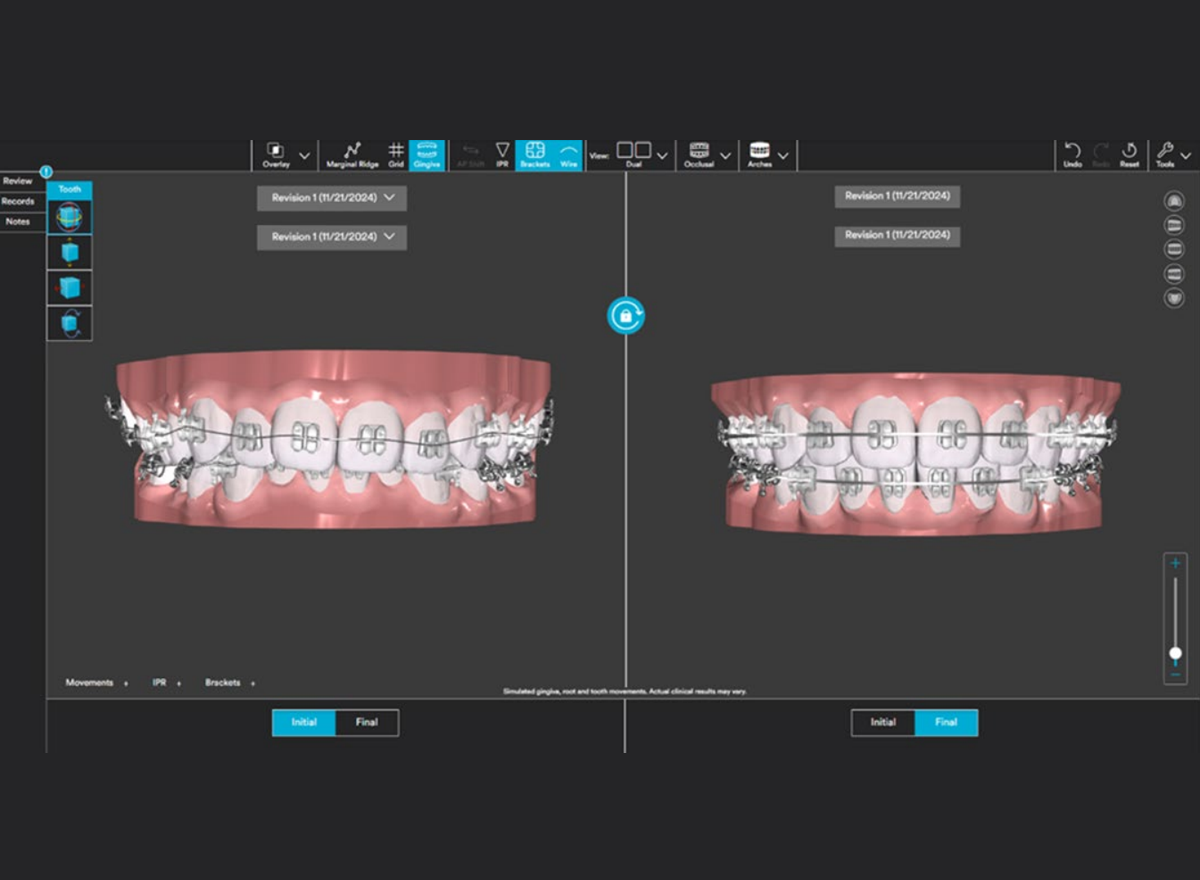
Direct indirect bonding, which involves placing each bracket individually, is the most common method to bond orthodontic appliances. However, this approach comes with a variety of challenges surrounding accuracy, consistency, ergonomics, patient comfort and efficiency. In response, new methods and tools have been developed to streamline workflows and help you achieve results quickly and effectively.
Digital bonding, or digital indirect bonding, is a recent orthodontic solution designed to streamline and improve the accuracy of bracket placement — so that you can deliver both the smiles and the experience that patients want. In this article, we’ll explore the digital bonding process, its supporting tools, and what it can do for your procedure and your practice.
For my digital bonding cases, I utilize the Clarity™ Digital Bonding System. This system involves using a patient’s digital scan to design a treatment plan with Oral Care Portal, which includes customized bracket positioning for simplified bonding. From there, a custom Digital Bonding Tray is delivered. With the Digital Bonding Tray, the brackets can be seated all at once.
In my practice, we prep using a standard phosphoric acid etch and 3M™ Transbond™ Plus Self Etching Primer. Then we use compatible APC™ Flash-Free Adhesive pre-coated brackets – choosing between 3M™ Victory Series™ Low Profile Brackets, 3M™ Clarity™ Advanced Ceramic Brackets or 3M™ SmartClip™ SL3 Self-Ligating Brackets with an MBT prescription. The advantage of the Digital Bonding system is that it’s basically the same process as direct bonding — but simplified. In fact, with this system, I can delegate the entire bonding process to my orthodontic team.
1. Create your ideal treatment plan in Oral Care Portal

2. A tray customized for patient is delivered in 10 days or less
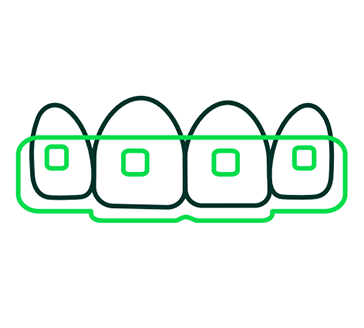
3. The tray delivers brackets with ease, efficiency and accuracy
When comparing direct and digital bonding, there are a number of variables to consider, including bracket placement timing and accuracy, team dynamics, number and length of follow-up appointments, length of treatment, patient experience, and the financial component of the treatment — the value per visit. These variables will impact the doctor, team, and patient differently, but overall, what benefits the practice will also benefit the patient.
Conventional orthodontic bonding can be difficult, complex and time consuming, but digital bonding simplifies the entire process. As mentioned above, the Digital Bonding Tray enables us to seat a full arch of brackets all at once, which saves a great deal of time.
With this streamlined process, it’s not uncommon for us to see patients and take them through isolation, the bonding procedure, curing, and retractor removal in just 15 to 20 minutes. That is incredible because direct bonding can take nearly twice as long. Much of that time is waiting for the doctor — during isolation, during individual bracket placement, during retractor removal. All of this waiting adds up.
Unfortunately, direct bonding also means building inaccuracy into the case — which can add even more time to the appointment. No matter how skilled you are, it’s incredibly difficult and time consuming to place each bracket by hand, much less to ensure consistency. This can lead to more appointments, more phone calls and longer treatment times. With digital bonding, on the other hand, I’ve seen parents who watch their kids go through treatment and are surprised at the turnaround time, saying “that’s it?”.
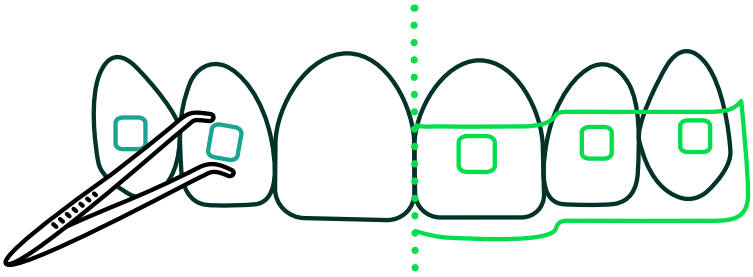
When it comes to bracket placement, starting strong is key. The sooner you get a bracket on accurately, the sooner that tooth will have time to express the movement. When a bracket is placed improperly, the movements and inaccuracies compound over time.
For example, if we have an 18-month case but the bracket isn’t placed correctly until month 12 or 13, then that tooth doesn’t have a lot of time to work on torque, rotational control, or tip in or out. While some of these movements express quickly, torque takes a long time. The faster I can get a rectangular wire to start expressing torque, the faster we’ll get the torque to where we want it. In my practice, we regularly change to rectangular wire by visit three, about 4 to 6 months in. Then by 8 months in, we’re on the final wire for the next 3 to 8 months. That’s a long time to allow torque to express rather than having to reposition.
Direct bonding is a more circuitous route because you can end up moving things you don’t intend to and having to recorrect, which takes longer because you’re moving the tooth more. With Digital Bonding, it’s a much straighter path. The movements are planned with intention from the start using Oral Care Portal and are accurately seated using the Digital Bonding Tray. That means fewer visits and shorter overall treatment times.
One of the major differences between direct and digital bonding is team involvement. Unlike direct bonding procedures that are very doctor-focused, digital bonding is truly a team effort.
During a direct bonding procedure, the team acts more like assistants or adjuncts. They’re still very important to the procedure, but they are assisting (and often waiting for) the doctor to check in on every step. Digital bonding, on the other hand, can be completely delegated to the team. They bring the patient back, isolate, bond the brackets and are ready to go tying in the wires. I don’t need to come over until it’s completely finished.
It gives the team a level of autonomy and responsibility that they love — and they also love not having to wait for the doctor. This means things can move more quickly and smoothly, even when you’re running late, which is particularly advantageous when you’re treating squirrelly kids.
Recall appointments are an essential part of orthodontic treatment, as they assess the patient’s progress and identify any issues as quickly as possible to help determine if they’re ready for the next stage of treatment or if anything needs to change.
Generally, as long as things are well controlled and we do our job right, the teeth will be moving with intention towards the goal. We’re still working with the biology of tooth movement and letting the wires do their job. However, as mentioned above, with direct bonding there’s no way to bond brackets with absolute accuracy, which can create undesired tooth movements that then require bending wires or repositioning the bracket. Digital indirect bonding solutions enable accurate placement, which leads to accurate movement. In turn, that translates to fewer visits overall and shorter treatment times.
Panoramic radiograph and repositioning (pan-repo) appointments are our opportunity to address any issues, inaccuracies or unwanted movements during the treatment process. Digital Bonding has completely changed our workflow for these appointments.
In a traditional orthodontic workflow, you start with the initial wires and transition to thicker, more rigid wires as the treatment progresses. In my practice, we use an 0.018” slot for precise torque expression and work our way up to a .016x.022 NiTi. From there, we would schedule a 40-minute visit because we can assume the case will require bracket repositioning.
In contrast, with Digital Bonding cases, we do what’s called a pan and plan appointment: we take a panoramic X-ray, adjust whatever’s needed, such as the elastic space or closure, and confirm that we don’t need to reposition anything. More often than not, we don’t have to repo. Our 40-minute appointments have been reduced to 20-minutes, where we can take a picture, take a look, and get patients out the door — which is appealing for both clinicians and patients. If repo is necessary, we plan it for the next visit.
This process has increased treatment efficiency overall — we can get patients through treatment in fewer visits. We’re averaging almost three fewer visits with Digital Bonding compared to direct bonding, which accumulates over time with the load of patients. This gives us the opportunity to see more patients on a given day, or we can run the office with fewer team members — reducing stress while still providing efficient care.
While your primary goal as a dental professional is to create and maintain healthy, beautiful smiles, ensuring your practice meets the bottom line is still top of mind. Particularly when introducing a new treatment, you want to make sure it translates to improved efficiency and ultimately, profitability.
Certain key factors help us measure efficiency:
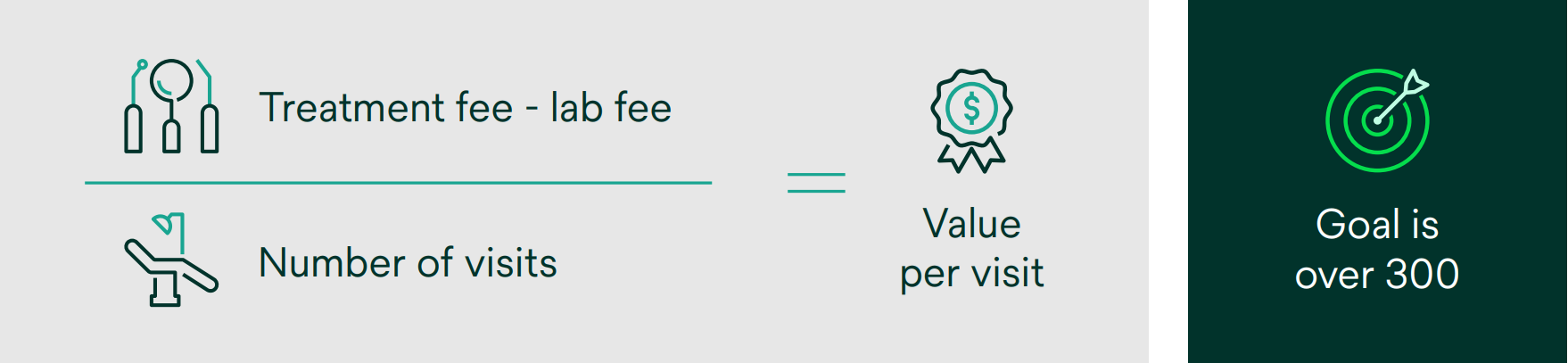
“Value per visit” is the average amount of revenue a practice generates from a single patient visit. However, tools to calculate this number don’t often include lab fees, which can have a huge impact on the bottom line.
To address this, our practice adds the lab fee into the equation. We calculate our net value per visit by subtracting the lab fee from the overall treatment fee before dividing by the number of visits throughout the treatment itself. At my practice, our goal is for this ratio to exceed 300, which is he average value per visit for our direct bonding cases, but these numbers will vary between offices. When looking at these numbers, we can see where we need to adjust to increase efficiency, whether that means revising treatment fees or finding alternate treatment methods.
For example, aligners can be very efficient, but they come with a significant lab fee. So, if you aren’t being more efficient, your value per visit will be really low with a hefty lab fee. Digital Bonding, on the other hand, consistently has a lower lab fee. When comparing our Digital Bonding cases to our direct bonding cases, our value per visit is higher in Digital Bonding cases. And we’re already above average for our direct bonding cases!
If it weren’t for flash-free brackets, we wouldn’t be doing any digital indirect bonding. In fact, there’s no good reason to do indirect bonding at all, conventional or digital, if you have to spend 5-10 minutes cleaning up flash afterwards. It ruins all the efficiency you gain from the initial appointment.
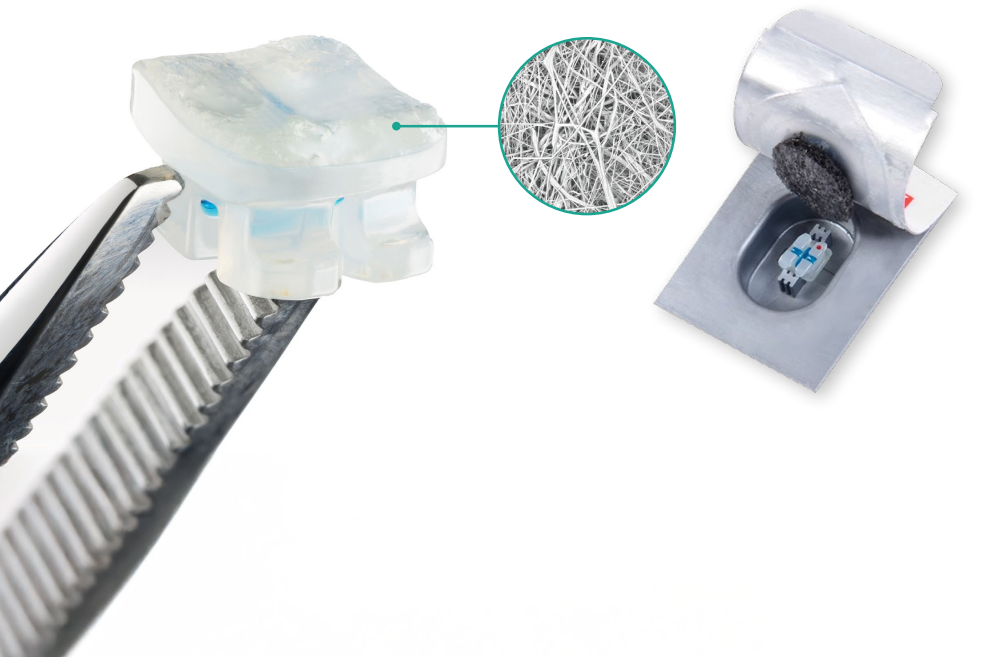
As the name implies, flash-free brackets eliminate the need to remove excess adhesive, or “flash,” after placement. Traditionally, bracket placement involves placing a bonding agent to the tooth and/or the bracket before seating, which can lead to extra adhesive leaking out the sides that could discolor or stain if not removed. APC Flash-Free Adhesive Coated Brackets, on the other hand, feature a compressible nonwoven mat soaked with a precise amount of adhesive resin that, when seated, seeps out to fill the space between the appliance and tooth exactly where needed and without any excess.
They’re also hugely beneficial for direct bonding cases because the brackets come in a blister pack rather than loose in a container — which gives patients peace of mind in a post-COVID world. Plus, you can place the bracket and not worry about bumping it while cleaning up the flash. You can open the blister pack, place the bracket, push it onto the tooth, and not touch it again. It’s significantly more efficient for direct bonding and it enables us to do indirect bonding in the first place. And while these brackets may have a higher price point than conventional brackets, they save costs elsewhere. By simplifying treatment, we can save a few visits, run with fewer team members, or even reduce our open days, which translates to significant savings.
As with any new procedure, flash-free placement does come with a learning curve for team members, but it’s not too difficult to learn. It doesn’t have the variables of more complicated direct bonding protocols that can lead to broken brackets, bond failure, and extra appointments. Once mastered, they can be completed quickly and easily. These brackets also have an advantage in multi-group or multi-doctor practices like mine. While every doctor has their preferred bonding method and places brackets a bit differently, digital indirect bonding presents an opportunity to standardize. If a patient ends up seeing different doctors, it’s more likely we can accurately and consistently work on the same smile.
Oral Care Portal further enhances our Digital Bonding procedure. Instead of having to piece together multiple websites, Oral Care Portal is an all-in-one solution to get everything you need for all your orthodontic patients: aligner, fixed, hybrid and retainers. It’s an incredibly intuitive system that gives you control and flexibility throughout treatment. You can design,
analyze and refine your treatment plan all in one place whether you’re planning your Digital Bonding case with ceramic or metal brackets.
It’s important to note that you can still get the same results from both digital indirect and direct bonding. The difference is how you get there: Digital Bonding helps you achieve those same results more efficiently and accurately. And that can make a big difference for you, your practice and your patients.
© Solventum 2025. Solventum and the S logo are trademarks of Solventum or its affiliates. 3M and the 3M logo are trademarks of 3M. Other trademarks are the property of their respective owners.