



Oct 1, 2026
/ What if a simpler shade system helped you deliver more confident results for your patients?
October 2, 2026
With Dr Chris O’Connor (Incidental Training)
After implementing 3M™ Filtek™ Easy Match Universal Restorative, a simple-to-use composite restorative with a simplified shade system, Dr Chris O’Connor speaks about his experience with the solution in his complex restorative workflows, alongside other key materials from the Filtek™ Dental Restorative range.
Under what clinical circumstances do you select 3M™ Filtek™ Easy Match Universal Restorative, and which factors most strongly influence that choice in everyday restorative practice?
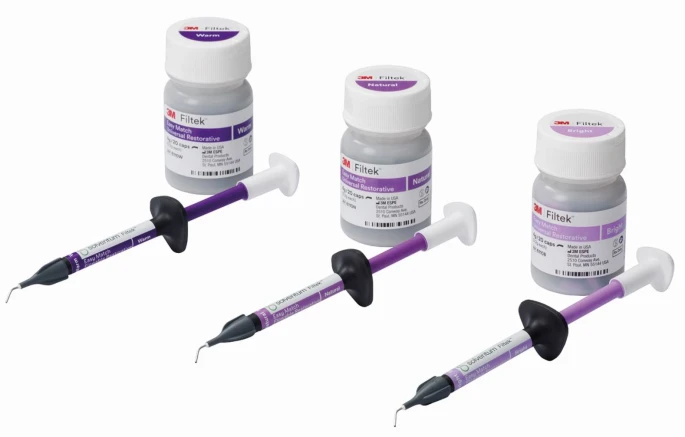
Where Filtek Easy Match Universal Restorative shines is routine anterior and cervical work: small-to-moderate Class IIIs, small Class IVs, and above all cervical Class V lesions (where its blending is exceptional) that’s the one I’ll grab every time. The shade choice tends to follow the clinical picture: Warm a great deal for older patients’ Class Vs, Natural for most Class IIIs, and Bright for lighter teeth or where I’m not blending into a single tooth at all but doing a full-coverage addition such as a composite veneer or a larger facial build-up, where its lightness gives an aesthetically pleasing results.
In the posterior 3M™ Filtek™ One Bulk Fill Restorative and 3M™ Filtek™ Bulk Fill Flowable Restorative do my heavy lifting, but it has a valuable secondary role as a capping layer in a more aesthetically demanding case, particularly over cusps, where a bulk fill on its own can read slightly grey. A thin top layer of Filtek Easy Match Universal Restorative warms that and gives a more natural surface.
3M™ Filtek™ Supreme XTE Universal Restorative has been a workhorse of mine for the best part of twenty years, and I think of Filtek Easy Match Universal Restorative as a brother to it, the same lineage and base chemistry, with simplified shade selection and improved opacity.
In which clinical situations do you prefer Solventum™ Filtek™ Easy Match Flowable Restorative, and how does its use support conservative and predictable restorative techniques?
The indications for the flowable are essentially the same as for Filtek Easy Match Universal Restorative, and I so often use the two in combination. There are times I’ll use the flowable alone, typically where access is tight in a smaller cavity, small Class Vs, diastema closures and Class IIIs. More often, though, I use the two together, and that’s where the shade match between flowable and paste really matters. It’s exceptionally good and that’s not something you can take for granted, even within the same family of composites.
A lot of my anterior work uses an injection or “snowplough” technique. For a diastema closure, for instance, I’ll place flowable and cure it to establish the first ‘hip’ of the proximal wall so I’m not crushing the matrix band then add a little more flowable and inject the paste composite into it.
With flowables you don’t need more than three shades, so I just carry Bright, Natural and Warm now the one thing I’ll still keep alongside is an Extra White from the 3M™ Filtek™ Supreme Flowable Restorative range for a genuine bleach case.

How does shade compatibility between Solentum™ Filtek™ Easy Match Flowable Restorative and the universal restorative influence confidence and predictability during restorative placement?
This is one of the most important features of a flowable-and-paste pairing for me, that they genuinely match each other. The system is built in matched pairs: Filtek Easy Match Flowable Restorative partners the Filtek Easy Match Universal Restorative, just as Filtek Bulk Fill Flowable Restorative partners Filtek One Bulk Fill Restorative. Within each pair the cure depth, the shade and the polishability all correspond, so when I use them together there’s no discernible difference between the two materials at the interface and that’s exactly what you’re looking for.
How have the 3M™ Filtek™ Easy Match Universal Restorative, solutions shaped your approach to shade matching, and what impact has a simplified shade system had on both clinical workflow and inventory management?
For routine dentistry it’ll do everything. Where you might struggle is with large Class IV, where you sometimes want to layer in a different opacity the value can sit a touch low with a single shade no matter how well the opacity is balanced, but that’s genuinely high-end work, and even then you can get a very decent result with Easy Match alone.
The principle I always come back to is that shape and polish matter more than shade. Until you’ve got the contour and the surface right, there’s no point spending time on polychromatic layering. So for the many dentists working at a sensible everyday level, Filtek Easy Match Universal Restorative and Filtek Easy Match Flowable Restorative are all you need.
In which restorative scenarios do you select 3M™ Filtek™ One Bulk Fill Restorative, and how does it integrate into your posterior restorative workflow?
Filtek One Bulk Fill Restorative is probably my favourite material in dentistry. I’ve used it for around 95% of my routine posterior composites for the last four years. It’s a genuinely clever material. It has a different monomer structure, with an addition-fragmentation monomer that releases stress as it polymerises, so it’s much kinder to the tooth in terms of shrinkage. Stress relief in itself isn’t new, but what I think Filtek One Bulk Fill Restorative did that’s novel is the optical behaviour. It translucent as it cures, which gives a reliable depth of cure making the work more efficient and then as it sets the opacity changes and it becomes relatively opaque.
I also genuinely like the handling when heated and I particularly value that Solventum has done the work and gained the regulatory approval to confirm it’s safe to warm (e.g. with Solventum™ Filtek™ Composite warmer kit) and to warm repeatedly; that’s almost unique among dental materials.
A reliable depth of cure is non-negotiable. If the base of an increment is under cured you’ve got poorer mechanical properties, a weaker bond and a real risk of post-operative sensitivity, and the worst part is you can’t see it’s happened. I want genuine confidence the whole increment has polymerised, which means respecting the stated increment depths and cure times.
Shrinkage stress is what opens margins, debonds restorations and flexes cusps, and gives post-operative sensitivity. The clever part of modern materials is decoupling the two: getting enough cure at depth for efficiency without paying for it in stress on the tooth. That’s exactly why a stress-relieving chemistry matters to me, but I’d always add that technique is also important.
Never rush light curing, and check your unit at least weekly for output. Use sensible increments, pay attention to the cavity configuration, and never push the material past the cure depth the manufacturer claims.
How do direct composite restorative systems support efficient, minimally invasive treatment strategies across a broad range of clinical indications?
What I find genuinely exciting is how far it’s come. The early dentists working with the first microhybrids and microfills, different materials for anterior and posterior, a lot of staining, a lot of early failures would give anything to practise in the age we’re in now. Bulk fill restoratives have made a real difference to posterior composite, and something like 3M™ Scotchbond™ Universal Plus Adhesive, with silane built in, makes repair so much easier.
Drawing on your experience delivering hands-on courses, what guidance do you offer clinicians regarding material selection and handling to help achieve predictable restorative outcomes?
When I’m choosing a material I look for a track record, either the product has been on the market a good while, or the chemistry behind it has and I want to know that colleagues I respect are using it. Filtek Dental Restoratives tick those boxes. I’m a bit of a materials scientist at heart and I read widely, but I don’t chop and change often, because you get genuinely better with a system the more you use it. You come to know exactly how it behaves and handles, and that’s one less thing to think about because the truly difficult parts of dentistry are elsewhere: the isolation, the matrixing, the preparation, and managing the patient.
I would gently remind clinicians that healthcare is a business too. A minimal, well-chosen range means stock gets used rather than going out of date, it’s simpler for you and your nurse, and you’re more efficient which buys back the thing that matters most: time. Time with your patient, time on your matrixing, and time on the things only you, as the dentist, can do.
To learn more about Solventum, visit https://www.solventum.com/en-gb/home/oral-care/
For updates on trends, information and events follow us on Instagram @solventumdentalUK
3M Heath Care is now Solventum
This article was first published on September 25th on the British Dental Journal website. Source
Dr Chris O’Connor, CEO Incidental Ltd
Chris graduated in 2008 From Newcastle Dental School. In 2014 he left general practice and worked as a clinical academic at Newcastle Dental School undertaking clinical research and teaching restorative dentistry to undergraduate and postgraduate students. He previously held the role of deputy degree programme director of the Newcastle University Restorative MClinDent.

Chris set up Incidental Training in 2011 and has delivered well over 100 hands on practical courses on restorative subjects. Wanting to find a way to supply delegates with hard to buy equipment he cofounded Incidental Ltd in 2019 and now holds the role of CEO of the company.
Chris returned to primary care dentistry in 2022 and works part time in private practice in Newcastle Upon Tyne and works exclusively on referral, accepting referrals for complex restorative cases, particularly the management of tooth wear.
© Solventum 2026. Solventum, the S logo and Filtek are trademarks of Solventum and its affiliates. 3M and Scotchbond are trademarks of 3M company